
Self-Care
Self-care on this page means practical maintenance: physical health, mental health, boundaries, rest, movement, and the small choices that keep a person functioning.
Self-care also means knowing when a situation is draining you and setting boundaries before it takes too much. Going back home reminded me how easily old family trauma can pull people back into patterns they have tried to leave behind. For me, self-care means paying attention to those limits and not pretending that stress, pain, sleep, food, exercise, and emotional strain are separate problems. The work here treats self-care as maintenance that protects health, judgment, and the ability to keep moving forward.
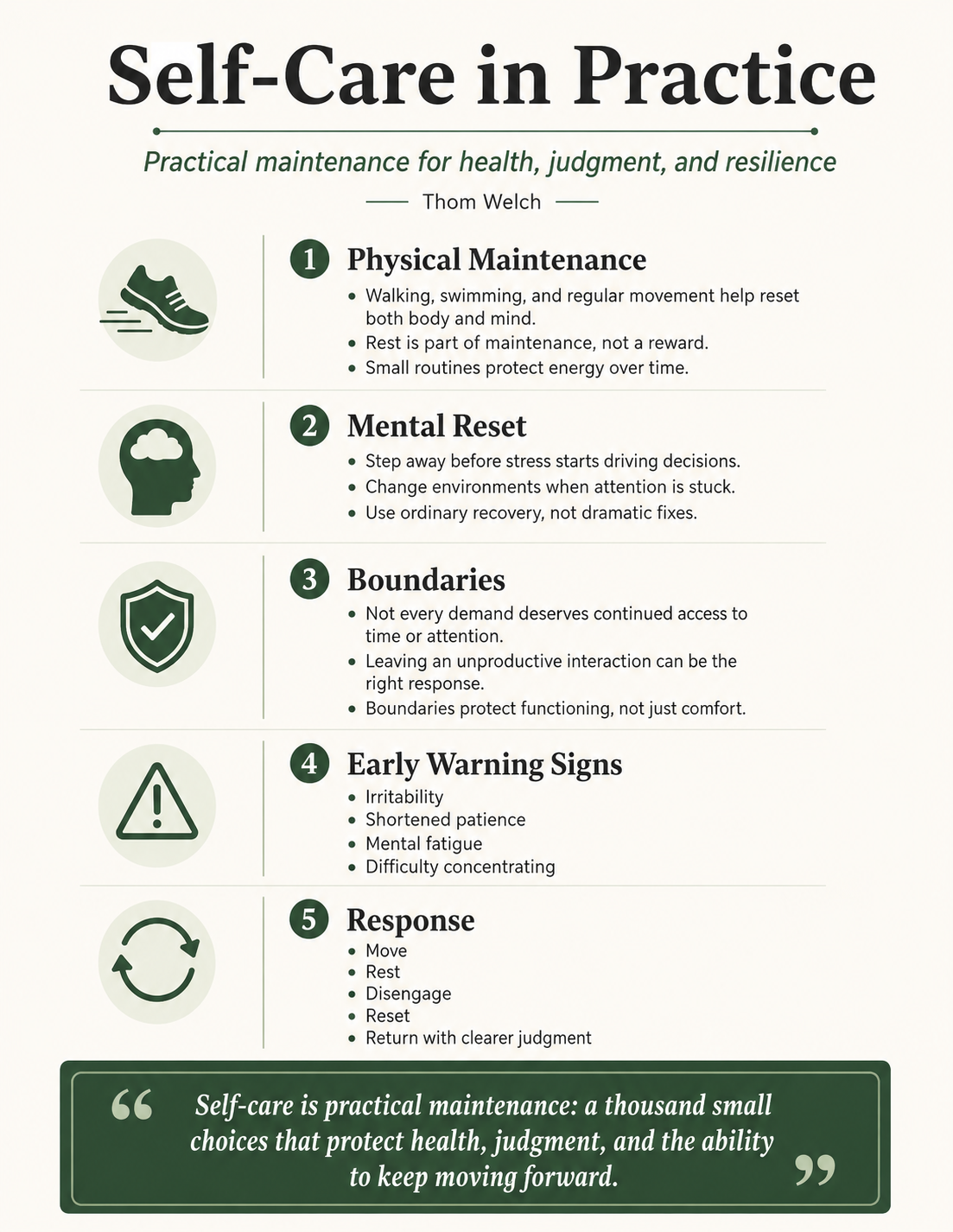
This visual summary outlines the practical self-care habits and warning signs that help me maintain functioning, judgment, and resilience.
Effects of an Eight-Week Mindfulness Meditation Program on Perceived Stress in U.S. Workers (Research Proposal)
PSY 222 | Research proposal
This research plan proposes an experiment testing whether an eight-week digital mindfulness meditation program reduces perceived stress among full-time U.S. workers compared with a waiting list control condition. Building it meant working through each stage of a study: a research question and testable hypothesis drawn from three randomized trials (Aikens et al., 2014; Chin et al., 2019; Radin et al., 2025), a volunteer sample of about 240 workers, random assignment, the PSS-10 as the outcome measure, and an independent-samples t test at p < .05. This artifact applies research methods to a practical question about stress and how people manage it while still working. The plan also had to stay honest about its limits. Meditation does not remove the workplace conditions that create stress, self-report can be shaped by expectations, and assignment to a program does not guarantee practice, which is why the design records daily meditation minutes.
Social Media, Self-Esteem, and the Social Self
PSY 355 | Course project
In this PSY 355 paper, I examined how social media shapes self-esteem and the social self through six lenses: adequacy, confirmation, comparison, reciprocity, profile identity, and constructive action. Drawing on Festinger's social comparison theory, Cingel et al. (2022), and Rüther et al. (2023), I argued that measuring adequacy against staged, filtered, or sponsored posts means comparing real life to something partly fake. Cinelli et al. (2021) helped me explain how echo chambers make agreement feel like proof, and Voggenreiter et al. (2024) showed that likes can affect mental health, social connection, and self-esteem. Writing it changed how I think about self-care. Protecting my self-esteem means noticing when I judge my progress against results other people chose to publish, and not treating a missing like as a verdict on a relationship. It also means using social media for resources and useful action, instead of letting it set my standards.